
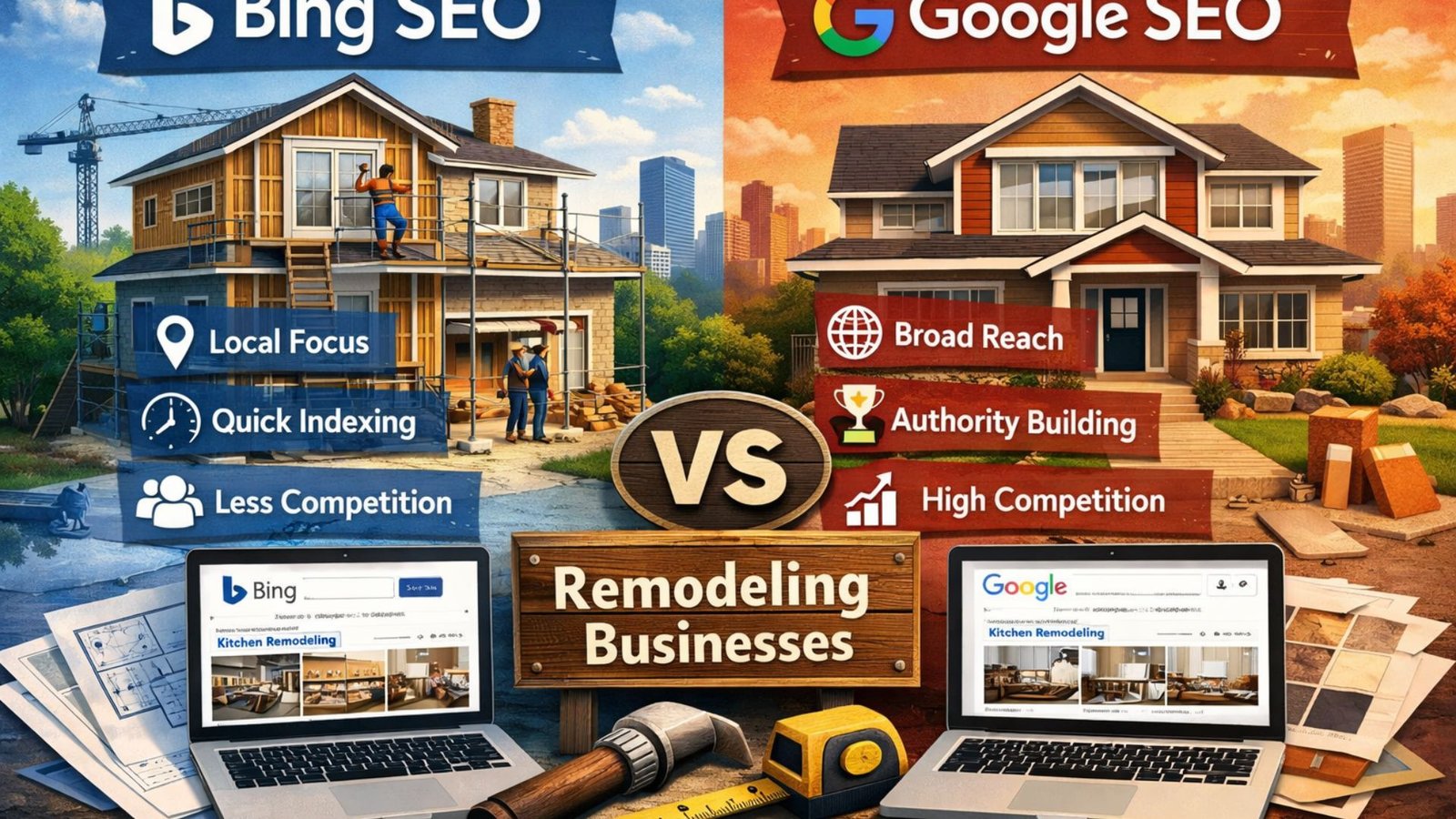
If you’re a remodeling contractor trying to attract more homeowners online, you probably already know that showing up in search results is a big deal. But here’s where it gets tricky: most business owners focus only on Google SEO, forgetting that Bing also exists, and in some markets, it can be surprisingly valuable.
So, is optimizing for Bing really worth it? How is Bing SEO different from Google SEO? And what should remodeling businesses prioritize when building an online presence?
Let’s break this down clearly and practically, so you can make smarter decisions for your remodeling company.
Why Remodeling Businesses Should Care About SEO Platforms
SEO isn’t just about “getting found on Google.” It’s about driving qualified traffic, homeowners who are actively looking for remodeling services in your service area, to your website. And once they’re there, converting that interest into leads and appointments.
Here’s where things shift: while Google owns the lion’s share of search traffic, Bing still powers millions of searches every single day, especially among older homeowners who use Microsoft Edge or default Windows settings.
For remodeling contractors, that demographic, often homeowners aged 45+, can be your best audience.
Google vs. Bing: How the Platforms Stack Up
Most businesses default to Google for SEO, and Google is undeniably the giant in the search engine space. But if Bing directs even 10-15% of all search traffic, ignoring it could mean leaving money on the table. That’s especially true for remodeling companies whose ideal clients are homeowners doing desktop searches during work or on home computers.
Let’s look at how the two platforms compare in key areas.
Search Market Share
- Google: Commands over 90% of the global market. Dominates mobile search.
- Bing: Typically captures around 6–9% of U.S. desktop search traffic. Small, but not insignificant.
While Bing’s share is smaller, many remodeling leads come from desktop users doing research about contractors in their area, a segment Bing serves well.
Demographic Differences
Bing’s audience skews older, more affluent, and more likely to own homes. That’s a meaningful detail if you’re trying to attract clients for kitchen or bath remodels.
- Google: Broad user base across all age groups
- Bing: Users are more likely to be over 35, own a home, and have a higher household income
That’s your customer base.
Algorithm and SEO Differences
While both engines reward good content and local relevance, their algorithms work a bit differently. Here’s a simplified breakdown:
Bing Likes:
- Exact-match keyword optimization
- Strong on-page SEO with keywords in titles, URLs, and meta tags
- Clear, structured content (H1s, bullet points, etc.)
- Social media signals (shares and engagement)
- Older, established domains
Google Prioritizes:
- High-quality, helpful content (think E-E-A-T: Experience, Expertise, Authority, Trust)
- Mobile-friendliness
- Site speed
- Backlink profile strength
- Behavioral signals (click-through rates, bounce rate, dwell time)
That means the same page optimized for Google may need slight adjustments to also perform well on Bing.
Want a deeper dive into the nitty-gritty? This article outlines the key Google vs. Bing SEO differences you should be aware of.
Local SEO: Similar Goals, Different Tools
Local search plays a huge role for remodeling contractors, especially when homeowners type in searches like “kitchen remodeler near me” or “bathroom renovation in [your city].”
Both Bing and Google offer local business listings, Google Business Profile and Bing Places for Business, but the visibility factors differ.
Google Business Profile (GBP)
For most remodeling companies, GBP is a non-negotiable. It feeds into Google Maps and the local 3-pack results that show up before organic links.
Optimizing your profile involves things like:
- Adding services (kitchens, bathrooms, etc.)
- Regularly updating photos and posts
- Getting homeowner reviews
- Ensuring accurate contact info
Bing Places for Business
If you’ve already claimed your GBP, good news: you can import that data directly into Bing Places. This gives you a shot at showing up in Bing’s local maps and knowledge panel.
For a homeowner using Bing to search for a contractor, that could be the difference between contacting you or your competitor.
Should You Optimize for Both Search Engines?
Short answer: yes, but with the right priorities.
If you’re strapped for time or budget, focus on Google first. But if you want a fully mature online presence (especially for high-value leads), Bing shouldn’t be ignored.
Here’s a quick decision guide for remodelers:
When to Prioritize Google SEO
- You haven’t optimized your site at all yet
- You want to maximize mobile traffic
- Your competitors dominate Google’s local pack, and you want in
When to Add Bing SEO to the Mix
- You already rank decently on Google
- You want to tap into desktop-heavy user segments
- You’re targeting affluent homeowners searching from work computers or desktops
- You want to stretch your budget without diving straight into paid ads
It’s not about picking one or the other; it’s about making both part of your long-term marketing strategy.
Practical Tips for Optimizing Both Google and Bing
You don’t need two separate strategies, but tailoring key areas can give you a leg up with both platforms.
Start with these essentials:
On-Page SEO
- Use exact-match keywords for Bing (e.g., “kitchen remodeling contractor in Austin”)
- Prioritize readability and structure for Google (short paragraphs, headings, natural flow)
- Make sure title tags and meta descriptions include city/keyword combos
Technical SEO
- Fast load times for Google
- Indexable sitemaps and crawlable URLs for Bing
- Secure hosting (HTTPS) for both
Content Strategy
Google loves long-form, detailed content like blog posts and service pages structured around user questions.
Bing responds well to concise landing pages that clearly address the keyword, offer a solution, and include a call to action.
At Remodel Growth, we build search strategies that capture both audiences, targeting ready-to-remodel homeowners across platforms. Because visibility doesn’t stop with Google.
How the Remodel Growth System Tackles SEO Across Platforms
The Remodel Growth system is built with one goal in mind: drive highly qualified leads that actually convert into remodeling jobs.
That starts with visibility, and SEO plays a critical role.
What makes our approach unique is that we don’t just “sprinkle in” keywords or build generic websites. We create end-to-end growth systems for remodelers that attract the right traffic from search engines (Google AND Bing), pre-qualify them into appointments, and automate the follow-up to keep your sales calendar booked.
More importantly, it’s not theory; it’s backed by proven client results.
Is Bing SEO Worth It for Remodelers?
If you’re only focused on Google, you’re battling with every other remodeler in your city over the same spot.
But if you’re also ranking on Bing, you’re quietly picking up valuable leads from a motivated, often-overlooked crowd, homeowners who take their time, do their research, and don’t always follow the herd to Google.
Adding Bing to your SEO efforts won’t double your leads overnight, but it can give you a measurable bump with the right type of customer.
And for remodelers, every lead counts.
Final Thoughts: How to Take the Next Step
Want to show up in more searches, convert more website visitors into actual appointments, and build a predictable remodeling pipeline?
Start by looking at your current SEO foundation. Are you ranking well in Google’s local results? Are you tapping into Bing’s share of home improvement searches? Are you driving the kind of traffic that turns into real jobs?
If the answer is “not really” or “I’m not sure,” let us help.
Explore our tailored marketing offer for remodelers, connect with our team, and see how we can help you build a genuine growth system, not just patch together a few tactics.
SEO isn’t just about rankings, it’s about real revenue. And we’re here to help you get both. Call us today.